
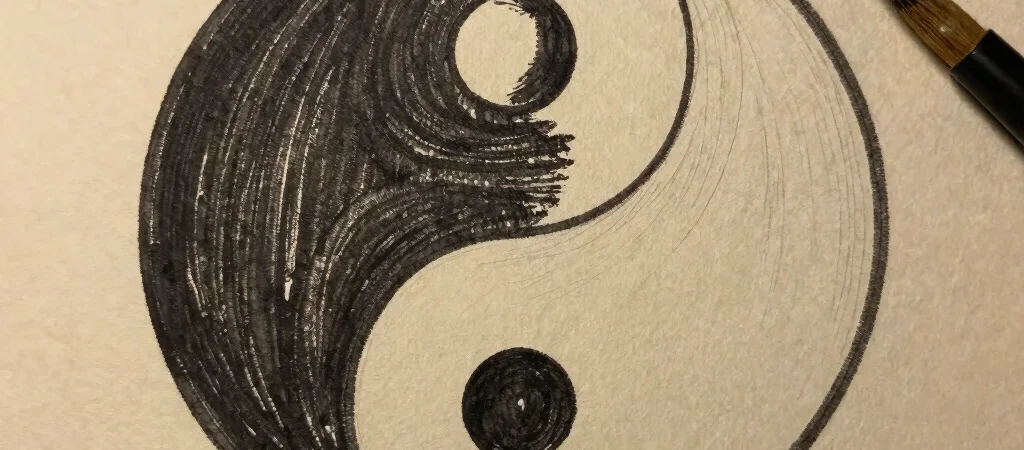
The black-and-white yin-yang symbol is recognizable almost everywhere, but recognition is not the same as understanding. It is often presented as a tidy diagram of two opposing forces. Taoist thought offers a more dynamic way to approach the relationship.
Think in Relationships
Yin and yang are commonly used to describe qualities in relation to one another, rather than as fixed labels for separate kinds of things. Night and day, stillness and movement, or shade and sunlight can be considered in relation to a particular setting. The emphasis is on how conditions meet and change, not on sorting the world into permanent teams.
That context helps explain why the symbol shows each side containing a small mark of the other. The image suggests that a quality is not sealed off from its counterpart, and that relations can shift. It is a useful visual prompt, but it cannot explain every Taoist teaching or practice on its own.
Avoid Turning It Into a Scorecard
A common shortcut is to assign a value judgment to each side, as if one must be better and the other worse. That misses the point of looking at relationships and changing conditions. A quiet pause, for instance, may be restorative in one moment and evasive in another; the label alone does not settle what is happening.
When studying yin and yang, begin with the specific passage, diagram, or practice where the terms appear. Ask what is being compared and how the relationship changes, rather than applying a universal chart to every situation. This keeps the symbol useful as an invitation to observe, not a shortcut that replaces context.